
MAXIMIZE YOUR SUMMER WITH EFFECTIVE SCIENCE PLANNING STRATEGIES

INTRODUCTION

Hey teacher friends, we've finally reached summer break—woohoo! I've been enjoying my break for three weeks already. If you know me, you know I can't truly relax in the summer without diving into school projects and getting a head start!
The summer is a perfect time for me to get ahead of things before the back-to-school rush kicks in at the end of July. This upcoming school year will be the first for a new science curriculum adoption with McGraw Hill. When a curriculum is adopted, a learning curve is in place, and extra grace is mandatory as teachers get to know the new platform and lesson progression. Luckily, our math curriculum is also through McGraw Hill, making the learning curve less steep.
INCREASING SCIENCE SCORES THROUGH VERTICAL PLANNING
To enhance science scores across grade levels, implementing a strategy of vertical planning is essential. Vertical planning involves collaboration among teachers from different grades to ensure a cohesive and progressive science curriculum. This approach helps to build a strong foundation of scientific knowledge that students can carry with them as they advance through their education.

BENEFITS OF VERTICAL PLANNING
Alignment of Curriculum: By coordinating with teachers from higher and lower grades, we can align our science curriculum to ensure that essential concepts are introduced at the right time and reinforced as students progress.
Shared Resources: Teachers can share resources, lesson plans, and effective teaching strategies that have proven successful in engaging students and enhancing their understanding of scientific concepts.
Continuity of Learning: Vertical planning fosters continuity in learning, allowing students to build on their knowledge year after year, which is critical for mastering complex scientific ideas.
Early Intervention: Identifying gaps in knowledge early on allows for timely interventions, ensuring that students are adequately prepared for the fifth-grade assessments.
OUR IMPLEMENTATION STRATEGIES
Regular Collaboration Meetings: We will hold science Professional Learning Communities for upper elementary grades to discuss curriculum goals and share insights on student progress.
Curriculum Mapping: We will create and share curriculum maps that outline key science concepts and skills for each grade level, ensuring that each year builds upon the last.
Professional Development: We will provide professional development opportunities focused on effective science teaching strategies that can be applied across grade levels. One of our first professional developments is scheduled for the week of pre-planning to train teachers on the district science fair.
Assessment Alignment: We will develop common assessments that reflect the vertical alignment of the curriculum, allowing for better tracking of student progress over time. During our school-based writing team, we held a mini-training on Penda Learning to discover ways we can assess students that align with district reading goals and science rigor.
By engaging in vertical planning, we can significantly improve our students' readiness for the fifth-grade science assessment and foster a deeper understanding of science throughout their educational journey. As a third-grade teacher, participating in these collaborative efforts is vital to setting my students up for success, not just for their upcoming assessments, but for their future academic endeavors.
As a third-grade teacher, participating in these collaborative efforts is vital to setting my students up for success, not just for their upcoming assessments, but for their future academic endeavors.
During our collaborative team discussions on essential standards, we consulted a list of benchmarks developed by a district writing team. This group, made up of teachers from across the county, met to discuss commonly assessed standards and determine essential standards using the R.E.A.L. tool. As I started planning the first major chapter, Chapter 2: Our Sun and Stars, I revisited this list to establish the purpose.
PLANNING A SCIENCE UNIT
When I plan any unit, be it math or science, I start with a unit outline. An outline can comprise of a variety of features, but the majority remain the same. In my science outlines, I include:
Big Idea and Essential Question
Benchmark Standards -- Essential Standards are highlighted in green
Vocabulary with Definitions
Physical Materials for Investigations/Labs
Digital Materials with Links
Lesson Pacing Guide
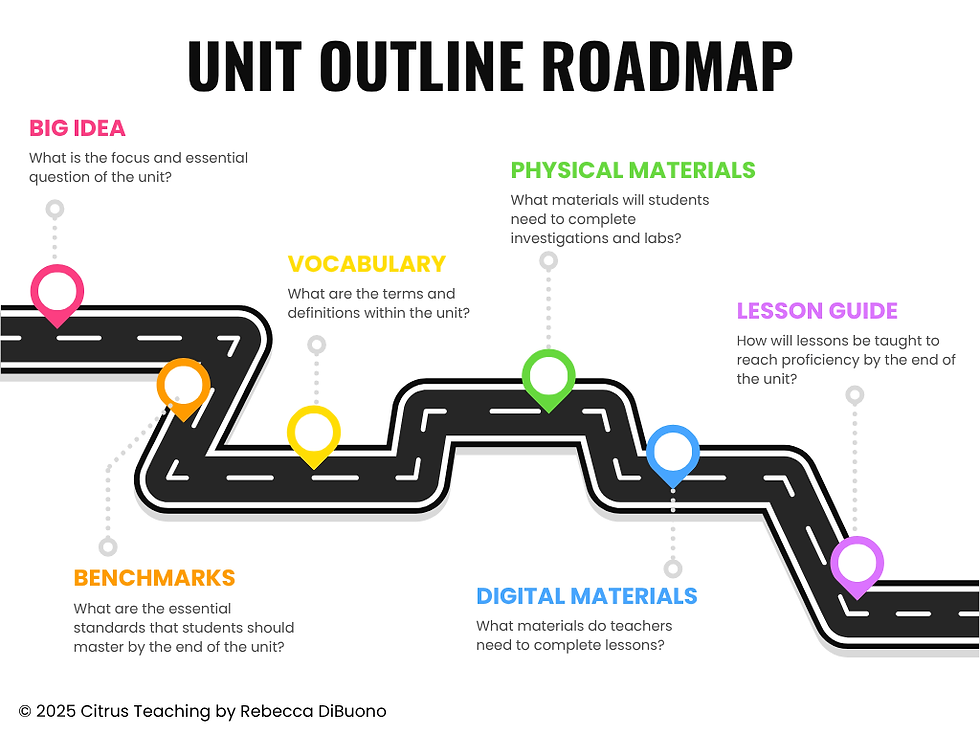
The Big Idea and Essential Question are derived from the curriculum opener. This will drive our focus and claim, evidence, and reasoning procedure throughout the unit. Following the Big Idea are the benchmark standards. Within this section of the unit outline, I highlight the essential standards that require mastery to ensure proficiency on the fifth grade standardized test. Although the benchmarks are labeled as essential, it does not mean that they are the only standards to be taught. The purpose is to identify standards to focus and spend more time ensuring a deep understanding in comparison to other standards.

The next sections focus on materials that are needed within the unit including vocabulary, investigation materials, and links to digital materials to make copies or use as reference. Within the McGraw Hill curriculum, an interactive anchor chart or word wall is needed when delivering vocabulary instruction and providing reference materials. This is where the vocabulary cards will come in handy. I printed all word cards for the units, cut, labeled, and laminated for longevity. On the back of each card is the term and corresponding unit/lesson. Before returning for the school year, I will be adding magnets to the back of each card to easily attach to my whiteboard at the back of my classroom.
During our meeting of 3-5 science teachers (I also teach math, but the fourth and fifth grade teachers are departmentalized in a three-way), we discussed essential standards and a variety of methods to provide common teaching practices. The McGraw Hill science curriculum has a heavy focus on vocabulary and the usage of science notebooks. These features are going to be a primary focus as we move forward. To teach vocabulary, all teachers well utilize Frayer models within the science notebooks. A Frayer model allows students to delve deeper into meaning by representing the understanding of the word through a definition, illustration, example, and non-example.

Digital and physical materials listed within the unit outline serve as an easy hub for locating a list of supplies for investigations and resources needed to provide instruction. Within the digital resource section, I link the accompanying slides and science notebook printables.

The last part of the unit outline is the daily lesson pacing guide. I entered a table with five columns to represent the days of the week. This helps when correlating with the school's events and district calendar. Each day has the date, day of unit, lesson title, and checklist of lesson highlights and activities. The idea is to provide my team with a snapshot of each day to easily reference in the midst of day-to-day chaos.
KEY TAKE-AWAYS
Incorporating outlines into your unit planning can significantly enhance the effectiveness of your teaching strategies. They provide a clear roadmap that helps in organizing content, ensuring all necessary topics are covered while allowing for flexibility in instruction. If you're looking for high-quality planning products that can streamline your process and elevate your lessons, be sure to check out my Teachers Pay Teachers store for the pacing calendar, unit outline, and lesson slides templates. Share your thoughts in the comments below!


%20(1)_edited.jpg)


Comments